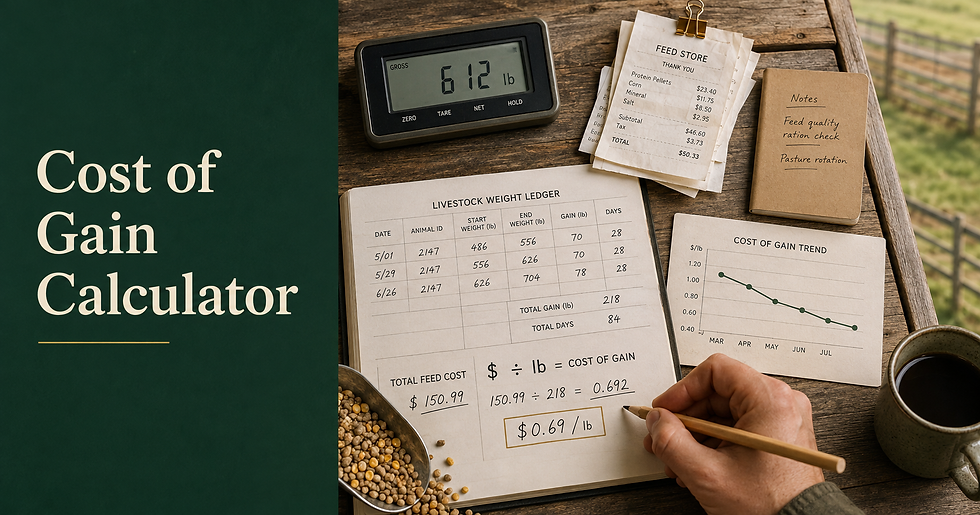
Average Daily Gain Calculator for Livestock

Use the calculator below to find how much weight an animal gained or lost per day between two measurements. Enter the starting and ending weights, choose pounds or kilograms, and use measurement dates from the same animal or comparable group.
Best answer

Average daily gain, or ADG, is the total change in weight divided by the number of elapsed days between two measurements. Subtract the starting weight from the ending weight, then divide by the number of days. A negative result means the animal lost weight during the period.
Key takeaways
ADG = (ending weight - starting weight) ÷ elapsed days.
Use the same weight unit for both measurements.
Compare measurements collected under similar conditions whenever possible.
ADG describes the measured period; it is not a universal feeding target or a diagnosis.
Use feed conversion ratio alongside ADG when you also need to understand feed efficiency.
How to calculate average daily gain
Use this formula:
ADG = (ending weight - starting weight) ÷ number of elapsed daysRecord the starting weight and starting date.
Record the ending weight and ending date.
Subtract the starting weight from the ending weight to find total gain or loss.
Count the elapsed calendar days between the dates.
Divide the total weight change by the elapsed days.

Average daily gain example
Let's dive in with the following example: a steer weighs 500 pounds on January 1 and 650 pounds on March 2. There are 60 elapsed days between the measurements.
Step | Calculation | Result |
Total weight gain | 650lb. - 500lb. | 150lbs. |
Elapsed time | January 1 through March 2 | 60 days |
Average Daily Gain (ADG) | 150lb. ÷ 60 days | 2.50lbs. per day |
The steer's average daily gain for that measurement period is 2.50lbs. per day. Please keep in mind, this average does not mean the animal gained exactly 2.50lbs. every day, it is simply a rough estimate daily average during that period of time how the weight gain increased.
How to interpret an ADG result
ADG is most useful as a consistent record you can compare over time. Genetics, species, age, sex, health, diet, water, weather, stress, management, and the length of the measurement period can all affect growth. Gut fill and the timing of weighing can also change a recorded weight, so be sure to use comparable weighing conditions when practical.
A result above or below a goal is a prompt to review the records and conditions, not proof of a cause. Avoid comparing unlike species, ages, production stages, or measurement periods as though they share one universal benchmark. Ask a veterinarian or qualified livestock nutrition professional about unexpected changes or feeding decisions.
What if the result is negative
A negative ADG means the ending weight is lower than the starting weight. First confirm that the dates, units, animal identity, scale, and recorded weights are correct. If the loss is real or unexpected, consider the animal's condition and seek appropriate professional guidance. The calculator does not diagnose illness or recommend treatment.
Average daily gain (ADG) versus feed conversion ratio (FCR)
Metric | Question it answers | Basic formula |
How much did weight change? | Weight gain ÷ elapsed days | |
How much feed was used per unit of gain? | Feed consumed ÷ weight gain |
Used in tandem, these two measures work well together. ADG describes growth rate, while FCR adds information about feed efficiency. Use Farmbrite's Feed Conversion Ratio as part of the included Livestock Reports when you have feed-consumption records for the same period.

Track livestock growth in Farmbrite
A one-time calculator is useful for a quick check. Consistent records are more useful for finding changes and comparing periods.
In Farmbrite, you can record animal measurements and retain the history behind the result. Livestock reports can display the latest weight, average daily gain, and feed conversion information so the numbers remain connected to the animal's other records.
Learn about Farmbrite's livestock measurement reports
Frequently Asked Questions (FAQs)
What does ADG stand for?
ADG stands for average daily gain. It is the average amount of weight gained or lost per day during a defined measurement period.
Can I calculate ADG in kilograms with this calculator?
Yes. Use kilograms for both weights and the result will be kilograms per day. Do not mix pounds and kilograms in one calculation.
Should I include the starting day?
Use elapsed time between the two dates. For example, January 1 to January 2 is one elapsed day. The calculator handles this automatically.
Can I calculate ADG from measurements taken on the same day?
No. Dividing by zero elapsed days is undefined. Use measurements from different dates.
What is a good average daily gain?
There is no single good value for every animal. Species, breed, age, sex, production stage, diet, health, environment, and management all affect an appropriate comparison. Use relevant professional or extension guidance for your situation.
Why might two ADG calculations differ?
Different measurement periods, scale conditions, time of day, gut fill, weather, health, diet, and management can affect the result. Compare records collected under similar conditions.
Is average daily gain (ADG) the same as feed conversion ratio (FCR)?
No. ADG measures rate of weight change. Feed conversion ratio compares feed consumed with weight gained.