Rotational Grazing for Livestock: A Practical Planning Guide for Healthier Soil, Better Pastures, and More Productive Farms

Updated: Apr 29
Rotational grazing has evolved far beyond simply moving livestock between paddocks. Today, many of the most successful farms are using it as part of a broader system by integrating multiple species, improving soil health, and even planting forages between grazing cycles to maximize productivity.
Done well, rotational grazing becomes less about the containment of livestock and more about working with natural systems: soil biology, plant recovery, and animal behavior.
This guide explores how to design a rotational grazing system that goes further: incorporating multi-species grazing, succession strategies, and soil-building practices, and all while showing how Farmbrite can help manage the complexity.
Let's take a quick look at what we'll be discussing herein:

Rotational Grazing as a System, Not a Technique
At its simplest, rotational grazing divides pasture into paddocks and rotates livestock through them. But the real value comes when you begin managing relationships:
Between plants and soil
Between different livestock species
Between grazing pressure and recovery time
Instead of asking, “Where do the animals go next?” the better question becomes:
“How does this grazing decision impact the next 30–60 days of pasture and soil health?”
Start with Soil Health: The Foundation of Every Grazing Plan
If there’s one concept that separates average grazing systems from high-performing ones, it’s soil health.
Healthy soil is alive with microbes, fungi, and organic matter working together to:
Cycle nutrients naturally
Improve water infiltration and retention
Support deeper root systems
Increase drought resilience

How Farmbrite Can Help
Farmbrite allows you to record what nutrients you are adding to your soils over time, as well as track the results of soil samples, giving you a holistic overview of the life cycle of both your crops and the soils they're raised in.
Check out our "Entering Nutrients or Soil Samples" how-to article.
Rotational grazing contributes directly to this when managed correctly. Short grazing periods followed by adequate rest allow plants to regrow and push energy back into the soil through their roots.
But mismanaged grazing, especially that of overgrazing, can reverse these benefits quickly.
Practical Soil Health Practices to Integrate
Avoid grazing below 3–4 inches of residual forage
Allow full recovery before returning livestock (Farmbrite automatically tracks "Days Rested" duration since the last grazing period for your locations)
Maintain ground cover to prevent erosion
Incorporate diverse forage species (grasses, legumes, and forbs)
Over time, these practices build organic matter, which is one of the most important drivers of long-term pasture productivity.
Designing Paddocks with Multi-Species Grazing in Mind
Traditional grazing systems often focus on a single species: cattle, sheep, or goats. But multi-species grazing allows you to use the pasture more efficiently by leveraging how different animals graze.
Each species prefers different plants and grazing heights:
Cattle primarily graze grasses
Sheep prefer forbs and shorter grasses
Goats browse shrubs and woody plants
Poultry scratch through manure, spreading nutrients and reducing parasites
By grazing multiple species on the same land, you can:
Improve forage utilization
Reduce weed pressure naturally
Break parasite cycles
Increase overall productivity per acre
This doesn’t necessarily mean running all animals at once; it often works best as a planned sequence.

Related Reading
To read more about this topic, check out our "The Rancher's Guide to Sustainable Grazing Practices" article.
Succession Grazing: Letting Animals Do the Work
Succession grazing (often called leader-follower grazing) is one of the most effective ways to increase pasture utilization while improving soil health and reducing external inputs. At its core, it’s about matching the right animal to the right stage of forage and residue, then moving them in a deliberate sequence through the same paddock.
Instead of asking one species to do everything (and inevitably leaving value behind), succession grazing allows each species to contribute to the system based on its natural behavior.
How Succession Grazing Works in Practice
Think of a paddock not as a single-use resource, but as a multi-layered opportunity.
When livestock graze, they don’t consume forage evenly:
Some plants are grazed first and aggressively
Others are ignored or lightly touched
Residual plant material and manure remain
Soil is impacted differently depending on hoof action
Succession grazing builds on this by introducing a second, and sometimes third, species to make use of what’s left behind.
A common sequence might look like this:
1. Cattle (Primary Grazers) - Cattle enter first and consume the tallest, most nutrient-dense grasses. Their grazing is relatively selective, and they tend to leave behind:
Shorter grasses
Broadleaf plants (forbs)
Some trampled forage
They also deposit manure, which becomes a key input for the next stage.
2. Sheep or Goats (Secondary Grazers/Browsers) - Sheep and goats follow shortly after, often within 1–3 days. They are less selective in the same way cattle are and will:
Consume forbs and weeds that cattle avoid
Graze closer to the ground (with care to avoid overgrazing)
Begin to even out pasture utilization
Goats, in particular, are effective for controlling brush and woody plants, making them valuable in mixed or transitioning pastures.
3. Poultry (Finishing and Nutrient Distribution) - Chickens or other poultry are introduced last, typically a few days after ruminants. Their role is different but highly impactful:
Scratch through manure pats, spreading nutrients more evenly
Consume fly larvae and insects, reducing pest pressure
Lightly disturb the soil surface, aiding decomposition
This final step helps accelerate nutrient cycling and reduces the need for mechanical intervention.
Timing Is Everything
The success of succession grazing depends heavily on tight timing between species.
If the gap is too long:
Forage quality declines
Parasite loads may increase
Nutrient opportunities are lost
If the transition is too fast:
Secondary species may not have enough material to graze
Pastures may be overutilized
A typical window is:
1–3 days for cattle
Followed immediately (or within a day) by sheep/goats
Poultry introduced 2–5 days later
These timelines should flex based on weather, forage growth rates, and stocking density.
Managing Parasites Through Sequencing
One of the less obvious but highly valuable benefits of succession grazing is natural parasite control.
Most internal parasites are species-specific. By rotating different species through the same paddock:
Sheep parasites are not picked up by cattle
Cattle parasites are not picked up by poultry
Life cycles are disrupted naturally
This can significantly reduce reliance on chemical dewormers over time, especially when combined with proper rest periods.
Avoiding Common Pitfalls
Succession grazing is powerful, but it can backfire without careful management.
A few things to watch for:
Overgrazing from cumulative pressure - Multiple species can unintentionally graze too aggressively if not monitored. Maintain residual forage height.
Poor paddock recovery - Just because multiple species use a paddock doesn’t mean it needs less rest. It often needs more!
Logistical complexity - Moving multiple species requires planning, infrastructure, and coordination.
This is where having a clear system and good farm records becomes critical. We have just the suggestion.
How Farmbrite Helps Manage Succession Grazing
As soon as you introduce multiple species and timed rotations, mental tracking breaks down quickly. Farmbrite helps bring structure to what can otherwise feel like a moving puzzle.

With Farmbrite, you can:
Log species-specific grazing events - Track exactly when cattle, sheep, or poultry enter and leave each paddock.
Visualize grazing sequences over time - See how paddocks are being used across multiple rotations and seasons.
Coordinate timing between species - Plan transitions so each group enters at the optimal moment.
Track outcomes, not just actions - Monitor pasture condition, animal health, and productivity tied to specific grazing sequences.
Over time, this turns succession grazing from an experimental practice into a repeatable, optimized system.
A System That Builds on Itself
When done well, succession grazing creates a compounding effect:
Better forage utilization leads to stronger plant regrowth
Stronger regrowth improves soil health
Healthier soil supports more diverse forage
More diverse forage supports more efficient multi-species grazing

It’s a system where each grazing cycle improves the next—reducing inputs while increasing output. And importantly, it shifts grazing from a task you manage… to a system that increasingly manages itself.
What to Plant Between Grazing Cycles
One of the most overlooked opportunities in rotational grazing is what happens between grazing events.
Instead of leaving paddocks to recover passively, many producers are actively improving them through targeted planting.
Common Forage and Cover Crop Options
Depending on your region and season, consider the following:
Cool-season mixes
Orchardgrass
Timothy
Clover (white or red)
Ryegrass
Warm-season options
Sorghum-sudangrass
Millet
Chicory
Plantain
Soil-building cover crops
Radishes (break up compaction)
Turnips (additional forage)
Legumes (fix nitrogen naturally)

Diverse mixes are often more effective than single-species plantings. They support soil biology, extend grazing seasons, and improve resilience against weather extremes.
In Pennsylvania and similar climates, integrating both cool and warm-season species can significantly extend grazing windows and reduce feed costs.
Planning Grazing and Recovery with More Precision
Once you introduce multiple species and planting cycles, grazing management becomes more dynamic, and as you might guess, more complex.
Key variables to manage include:
Grazing duration (often 1–3 days per paddock)
Recovery time (20–60 days, depending on growth conditions)
Species sequencing (who grazes when)
Forage regrowth stages
This is where many operations struggle—not because the system doesn’t work, but because it becomes difficult to track.
How Farmbrite Supports Advanced Grazing Systems
As grazing systems evolve, so does the need for better planning and recordkeeping. Farmbrite helps bring structure and visibility to multi-species, rotational grazing operations.

Map and Manage Complex Paddock Systems
Create and organize paddocks visually, making it easier to plan rotations, track usage, and manage multiple species across the same land.
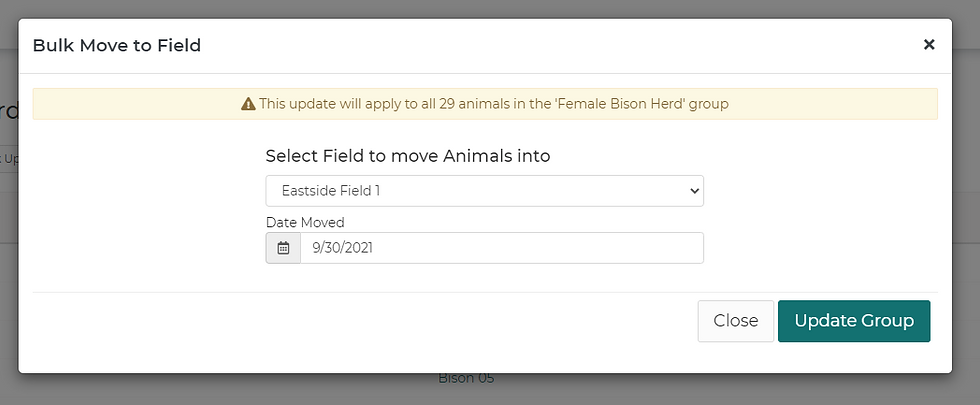
Track Multi-Species Grazing and Succession
Log which animals grazed which paddock and when. This is especially valuable for succession grazing, where timing and sequence matter.

Monitor Soil and Pasture Improvements Over Time
Record pasture conditions, forage growth, and inputs. Over time, this creates a clear picture of how your grazing strategy is impacting soil health and productivity.
How Farmbrite Can Help
Farmbrite includes a number of grazing reports pre-built, and the ability to create and customize your own, to help you monitor and plan your crop and livestock plans: Fields Being Grazed, Grazing History, Grazing Summary, Current Animal Location, and Location History, to name just a few.
Plan Planting and Grazing Together
Coordinate seeding schedules with grazing cycles so paddocks are not only resting, but actively improving between rotations.
Make Data-Driven Decisions
With centralized records, you can refine stocking rates, adjust rotation timing, and identify what’s working across seasons and years.
A More Complete Grazing System
Rotational grazing is no longer just about dividing land; it’s about managing ecosystems.
By integrating:
Soil health principles
Multi-species grazing
Succession strategies
Intentional forage planting
…you create a system that is more productive, more resilient, and more sustainable over time.
It does take more planning. But with the right approach and the right tools like Farmbrite, you can turn grazing into one of the most powerful levers on your farm.

Joshua, his wife Jenn, and their dog Rooster live in PA. Joshua is the owner and operator of Hoffman Appalachian Farm, where they grow Certified Naturally Grown hops. Joshua has over twelve years of experience in growing crops, including growing in an organic system. In his spare time, he enjoys trail running, backpacking, and cycling.


