Are You Breaking Even? A Practical Farm & Ranch Breakeven Analysis Guide

For many farmers and ranchers, the question isn’t just “Am I making money?”—it’s “Am I even breaking even?” Understanding farm breakeven analysis is one of the most important foundations of a successful farm or ranch operation. Breaking even is the point where your total revenue equals your total costs ... no profit, no loss ... but reaching that point consistently requires more than guesswork.
But here’s the challenge:
Most operations don’t fail because of one big mistake—they fail because they don’t truly understand their numbers.
This guide walks through how to measure breakeven, what reports and milestones matter, and how to use tools like a cattle breakeven calculator to make better decisions. Let's take a quick look at our topics;
What “Breaking Even” Really Means on a Farm
At its simplest:
Breakeven = Total Costs ÷ Total Production (or sale value)
But in real farm operations, it’s more complex because costs come from multiple places. Your true cost structure includes:
Feed (often your largest expense)
Labor (including your own time)
Equipment & depreciation
Land costs (rent or ownership)
Vet & medicine
Utilities, fuel, repairs
Interest and financing
Death loss or shrink
In cattle operations, especially, profitability depends on predicting both costs and future sale price, not just tracking what has already happened. This is why farm breakeven analysis matters so much. It gives producers a clearer understanding of what their operation truly costs to run and what price they need from the market just to stay sustainable.
5 Core Methods for Farm Breakeven Analysis
1. Enterprise-Level Profit & Loss (P&L)
Instead of one farm-wide number, break your operation into enterprises:
Cow-calf
Backgrounding
Feedlot/finishing
Crops (if integrated)
👉 Key metric:
Profit or loss per enterprise
Profit per acre or per head
Why it matters: You might be losing money in one enterprise and hiding it with profits from another.
2. Cost of Production (COP)
This is your per-unit cost:
Cost per pound of beef
Cost per bale of hay
Cost per acre
👉 Formula:
Total Costs ÷ Total Units ProducedMilestone:
You know your COP within ±10%
If you don’t know this number, you’re guessing ... period.
3. Breakeven Price
This tells you the minimum price you must sell at to avoid losing money.
👉 Example:
If your cost is $1.60/lb live weight
Your breakeven = $1.60/lb
Anything below that = loss
4. Cash Flow vs. Profit
A farm can:
Be cash-flow positive but unprofitable
Or profitable but broke (timing issues)
👉 Track:
Monthly cash flow
Annual profitability
Milestone:
You can survive low-price cycles without borrowing to operate
5. Benchmarking Against the Market
Compare your numbers to:
Local sale barn prices
Feed costs
Regional averages
If your costs are consistently higher than those of your peers, you’re at risk.
The Reports That Actually Matter
If you only track a few things, track these:
Monthly
Cash flow statement
Feed cost per head
Mortality/death loss %
Per Production Cycle
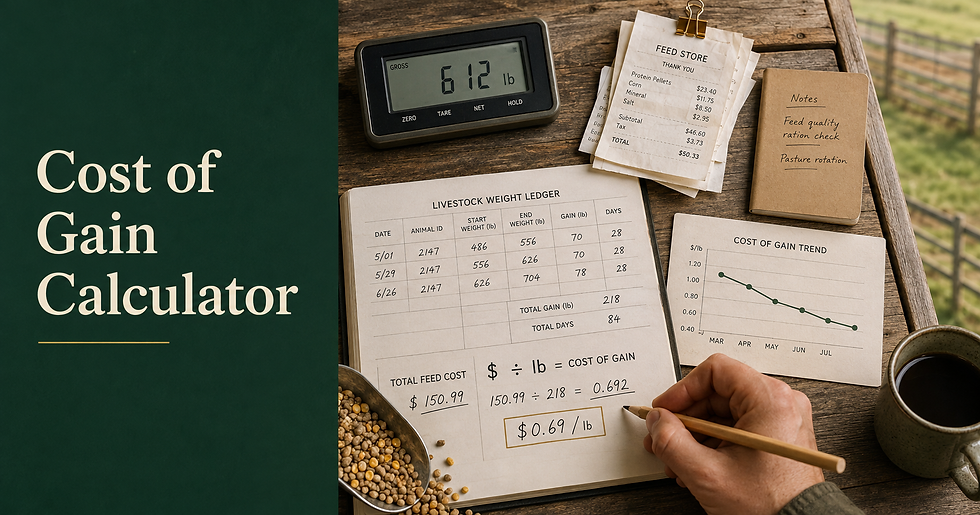
Cost of gain (COG)
Average daily gain (ADG)
Days on feed
Annually
Full P&L by enterprise
Cost of production
Breakeven price

Practical Example: Using a Cattle Breakeven Calculator
Let’s walk through how a tool like the Irsik & Doll Cattle Breakeven Calculator helps you make decisions. These tools estimate profit or loss per head by combining your inputs into a single breakeven number.
Step 1: Input Your Core Assumptions
Typical inputs include:
Purchase weight (e.g., 700 lbs)
Purchase price ($/cwt)
Days on feed
Average daily gain (ADG)
Cost of gain ($/cwt)
Vet & processing costs
Death loss %
Interest rates
Expected selling price
Step 2: What the Calculator Produces
The calculator estimates:
Final weight
Breakeven price ($/cwt)
Profit or loss per head
It essentially answers:
“At what sale price do I cover all costs?”
Step 3: Example Scenario
Let’s say you enter:
Purchase weight: 700 lbs
Purchase price: $220/cwt
Days on feed: 180
ADG: 3.2 lbs/day
Cost of gain: $110/cwt
Selling price: $185/cwt
Output (simplified):
Final weight: ~1,275 lbs
Breakeven: ~$190/cwt
Estimated loss: ~$60/head
👉 Translation: You’re losing money, even though the cattle look “good.”
Step 4: Scenario Planning (Where the Real Value Is)
The real power is adjusting inputs:
What if feed costs increase?
What if ADG drops?
What if prices fall $5/cwt?
Breakeven calculators let you test risk before you buy cattle, not after.
Key Milestones That Signal You’re Breaking Even (or Not)
You’re likely breaking even when:
✔ Your sale price ≥ breakeven price
✔ Cost of gain < value of gain
✔ Feed efficiency is stable or improving
✔ Death loss stays within the expected range
✔ You can withstand moderate price swings
You’re likely not breaking even when:
✖ You don’t know your cost per head
✖ You rely on “market hope” instead of numbers
✖ Feed costs spike, but pricing assumptions don’t change
✖ You skip enterprise-level tracking

Common Mistakes Farmers Make
1. Ignoring “Hidden” Costs
Labor, depreciation, and interest count ... even if you don’t write a check.
2. Using Old Numbers
Markets change fast. Breakeven must be updated constantly.
3. Not Stress Testing Scenarios
One set of assumptions is not enough.
4. Treating the Whole Farm as One Unit
You need enterprise-level clarity.
Using Farm Breakeven Analysis to Make Better Decisions
Understanding breakeven isn’t just accounting, it’s decision-making:
Should you buy cattle at current prices?
Should you sell now or hold?
Should you change feed strategy?
Should you scale up or pull back?
The most successful producers don’t just raise livestock—they manage risk with numbers.
Final Thoughts
You don’t need perfect data to get started—but you do need honest data.
Because the real question isn’t:
“How did I do last year?”
It's:
“If I repeat this exact same system, will I make money?”
If you can answer that confidently, you’re no longer guessing, you’re managing your farm like a business.

Joshua, his wife Jenn, and their dog Rooster live in PA. Joshua is the owner and operator of Hoffman Appalachian Farm, where they grow Certified Naturally Grown hops. Joshua has over twelve years of experience in growing crops, including growing in an organic system. In his spare time, he enjoys trail running, backpacking, and cycling.