An Ag School Digs In With Farmbrite: How They Manage Both Farming Operations and Hands-On Education

Many Agricultural Schools (Ag Schools) and training institutions operate working farms alongside classrooms, labs, and research plots. These farms aren’t just demonstration spaces, not by a long shot. They are living, breathing operations producing vegetables, livestock, grains, or specialty crops while also serving as hands-on learning environments for students.
Here in our hypothetical use case scenario, New Roots Agricultural Academy offers certificate programs, associate degrees, and community workshops, but they also faced a familiar challenge: how to manage a complex, real farm operation while also using it as an effective teaching tool. Production decisions, compliance requirements, student schedules, and instructional outcomes all needed to coexist in one system.

New Roots adopted Farmbrite to bridge the gap between farm management and agricultural education, enabling the organization to grow and sustain not only the crops and livestock they steward, but the young minds of the next generation of farmers.
These are the topics we'll be discussing within our use case scenario:
The Challenge of Managing a Dual-Purpose Farm
Before implementing Farmbrite, the New Roots relied on a mix of spreadsheets, whiteboards, paper logs, and separate learning materials.
This created several pain points:
Production records were fragmented across departments, making it difficult to get a clear picture of yields, costs, and profitability.
Students learned concepts like crop planning, input tracking, and enterprise budgeting in theory, but had limited exposure to the real data behind day-to-day farm decisions.
Instructors spent significant time reconciling records for food safety, organic practices, or grant reporting instead of teaching.
New student cohorts inherited inconsistent systems each semester, creating confusion and lost learning opportunities.
The school needed a single platform that could manage real farm operations while also reinforcing best practices and transparency for students, teachers, and staff alike. Farmbrite was rolled out across the school’s teaching farm, greenhouses, livestock units, and demonstration plots.

Rather than treating software as an administrative layer hidden from students, New Roots made Farmbrite a core part of its curriculum. Instructors configured the system to reflect the actual structure of the farm, its fields, barns, enterprises, work assignments, and production cycles so students could learn in a real-world context from day one.
Production Management: Running a Professional-Grade Farm
From an operational standpoint, Farmbrite allowed the school to manage its farm just like a commercial operation, because in essence, that is half of what New Roots actually is.
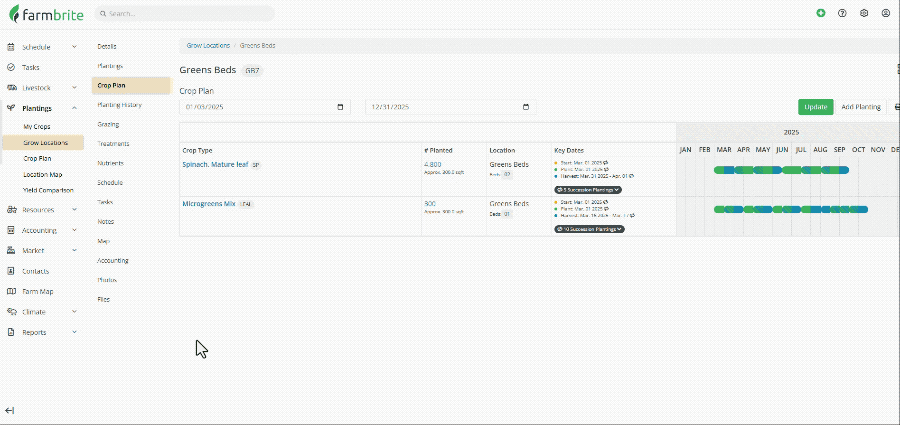
Crop plans were built at the start of each season, mapping out fields, beds, and boundaries. With the help of their instructors, students developed the planting schedules, determined the varieties, rotations, and expected harvest windows. As students participated in planting, transplanting, and harvesting, those activities were logged directly into the system, creating a living production record.
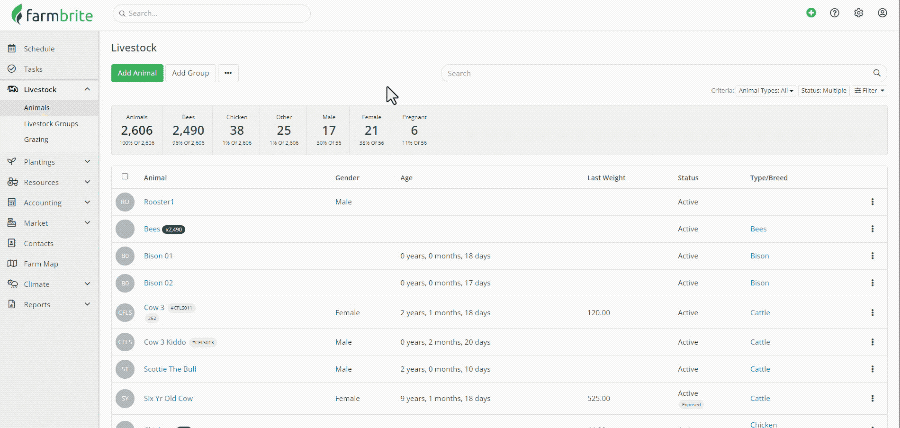
Livestock operations were developed with the same level of detail and planning. Livestock groups, feed usage, health treatments, and processing dates were recorded in Farmbrite, giving both instructors and students visibility into animal care, costs, and outcomes.
Input tracking became far more precise. Seeds, soil amendments, compost, and feed were logged as they were purchased and then used, allowing the school to understand the true cost of production while modeling responsible input management.

Because Farmbrite ties activities directly to financial data, the institution could evaluate which segments of the entire operation supported the school financially and which were primarily educational investments. This is an important distinction for both financial budgeting and grant justification.
With an extensive number of pre-built accounting reports such as Accounts Receivable, Profit & Loss, Cash Flow, Crops and Livestock Breakeven, and many more, along with the ability to create their own custom accounting, crops, livestock, orders, online market, resources, and user activity, New Roots is always in-the-know about each aspect of the operation.
Education in Action: Turning Data into Learning
What truly set the implementation apart was how Farmbrite became part of the classroom.
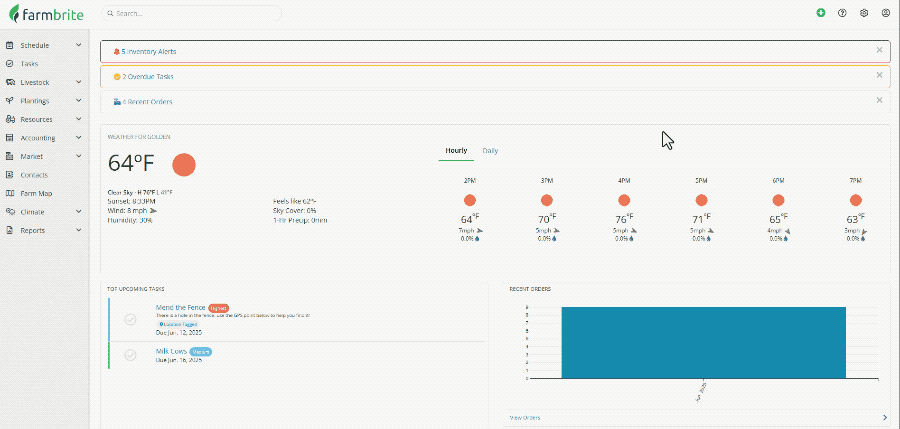
Students didn’t just learn abstract concepts like crop rotation or profit & loss, they worked with real farm data generated by their own labor. Instructors used Farmbrite dashboards during lectures to show how decisions made in the field affected yields, costs, and profitability.
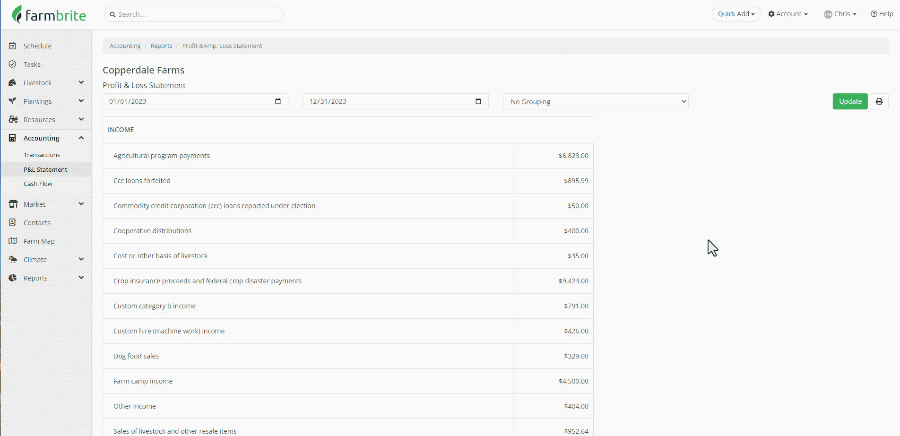
Assignments were built around the various areas of focus in Farmbrite (livestock, plantings, resources, etc.). Students analyzed crop and livestock production reports to identify any areas of concern, compared both crops and livestock performance, and proposed improvements based on actual outcomes. Because the data reflected a real working farm, the lessons carried weight and relevance.
Farmbrite also helped standardize learning across cohorts at New Roots. Each new group of students entered a system with historical data already in place, allowing them to compare crop and livestock plans and implementations, the impacts of weather, and overall farm management strategies over time. In comparison to farms without the educational component, where some, if not many, of its laborers return season after season, at New Roots, each new year brings a different team of student labor, so having detailed records and activity notes to pass from one cohort to the next is crucial.
Compliance, Transparency, and Institutional Reporting
As an educational institution, the school also had to meet compliance and reporting requirements that went beyond typical farms.
Farmbrite simplified recordkeeping for food safety and traceability, organic practices, and institutional audits. Instead of pulling records from multiple systems, administrators could generate reports directly from Farmbrite, saving time and reducing risk.

For grant-funded programs and research plots, Farmbrite provided clear documentation of activities, inputs, and outcomes. This transparency strengthened the school’s ability to secure funding and demonstrate impact to stakeholders.
Collaboration Between Staff, Students, and Departments
One unexpected benefit was improved collaboration. Instructors, farm managers, and administrators all worked from within Farmbrite, reducing miscommunications and duplicated efforts.
Permissions allowed students to view and enter data relevant to their coursework without compromising administrative controls. Farm managers retained oversight, while instructors tailored how the platform was used in their classes.
This shared visibility helped break down silos between “operations” and “education,” reinforcing the idea that good farming and good teaching go hand in hand!
Results: Better Farmers, Better Systems
After adopting Farmbrite, the agricultural school saw tangible improvements:
Farm operations became more organized, data-driven, and financially transparent.
Students graduated with hands-on experience using modern farm management software, giving them a competitive edge in the workforce.
Instructors spent less time chasing records and more time teaching critical thinking and decision-making.
The institution gained stronger reporting capabilities for accreditation, grants, and community partnerships.
Most importantly, New Roots itself became a richer learning environment, one where every task, from planting a bed to balancing a farm budget, contributed to both production and education.
A Model for Modern Agricultural Education
As agriculture becomes more data-driven and complex, schools and training institutions play a crucial role in preparing the next generation of farmers, managers, and agribusiness professionals.

By using Farmbrite as both an operational tool and an educational platform, New Roots Agricultural Academy demonstrated that teaching farms don’t have to choose between realism and instruction.
With Farmbrite in place, they can do both.
These are examples of real-world scenarios that we have seen through the years at Farmbrite. We share them here for reference for other customers, schools, and farms to see the use case scenarios. To see Farmbrite, farm management software in action, open a free trial.

Joshua, his wife Jenn, and their dog Rooster live in North Central Pennsylvania. Joshua is the owner and operator of Hoffman Appalachian Farm, where they grow Certified Naturally Grown hops. Joshua has over twelve years of experience in growing crops, including growing in an organic system. In his spare time, he enjoys trail running, backpacking, and cycling.


