Small Land, Big Impact: How a Micro-Farm Uses Farmbrite to Run a Lean, Profitable Operation
- Joshua Brock
- Apr 15
- 7 min read

While there is no single, codified definition, a "micro-farm" is generally understood to be:
An intensively managed farm operation typically under 5 acres (often 1–2 acres or less), focused on high-value crops or products, serving local markets such as CSA members, farmers markets, restaurants, or direct-to-consumer sales.

On 1.5 acres just outside a mid-sized, New England town, our hypothetical operation, Meadow Bend Micro-Farm, grows mixed vegetables, culinary herbs, and specialty salad greens. The farm serves:
65-member CSA
Two weekly farmers markets
Three locally owned restaurants
Owned and operated by the husband-and-wife team of Katie and John, the farm employs one seasonal helper from April through September. Every square foot counts. Every planting decision matters. And every day must produce value.
For the first two seasons, operations were managed with spreadsheets, notebooks, whiteboards in the wash station, and memory. By year three, the cracks really began to show:
Succession planting dates started to be missed
Katie and John were seeing inconsistent harvest records
Input costs became more and more difficult to track
There became a lot of uncertainty around profitability per crop
CSA member data (contact information, orders, notes, etc) was scattered across platforms and often not up to date
They started to see that record-keeping was very important. That’s when Meadow Bend implemented Farmbrite for their farm record keeping.
The Challenge of Running a Micro-Farm

Micro-farms operate differently than larger commodity farms. Typically these farms are highly diversified, intensively planted making the most of the smaller footprints they typically occupy, highly margin-sensitive, and labor-constrained. By labor-constrained we mean their workforce is most often smaller in numbers, pressed for high efficiency, pulled in many directions, and thus can be difficult to recruit for.
Because of that, organization isn’t optional; it's a necessity and the only way the farm can survive. Katie and John knew they needed one centralized farm management software to manage:
Farmbrite became their digital farm office, and they've never looked back. Let's take a quick look at our areas of focus for this article:
Crop Planning: Turning 1.5 Acres into a Production Engine
Micro-farms rely on succession planting and tight rotations to maximize yield per square foot.
Using Farmbrite’s crop planning tools, Meadow Bend now:
Instead of guessing when a bed will be available, they know.
For example, once spring spinach harvest concludes, the system already shows that the bed transitions to summer basil, then fall carrots. This prevents idle ground—something a micro-farm simply cannot afford.
Maps Every Bed and Greenhouse Space Digitally
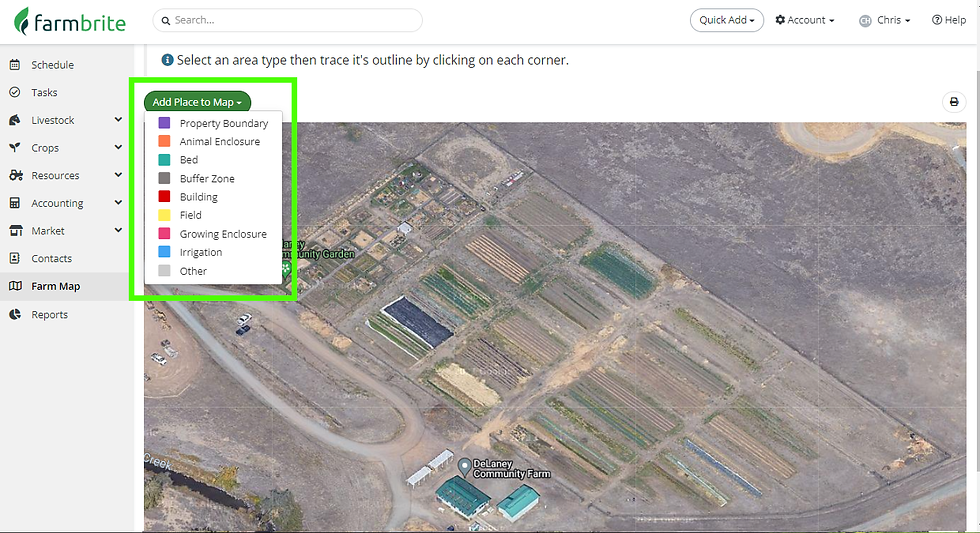
Farmbrite's Farm Map tool allows our farm owners to outline their fields, the beds within those fields, enclosures whether they're for crops or livestock, as well as buildings and irrigation. It gives Katie and John a great way to see the overview of their property.
Mapping their farm also enabled automatic calculations of estimated plant counts, which then factored into their estimated harvest revenue. John found this to be an incredible time-saver compared to his usual spreadsheets that attempted to map beds and plants in cells. Once Katie and John mapped their operation, they used the My Crops area of Farmbrite to add their crop types and the specific crops themselves.
Assign Crops to Specific Beds

Working hand-in-hand with the My Crops area of Farmbrite, Grow Locations is its companion. First, you defined WHAT you grow, next, WHERE you will be growing it. Given the small footprint of a micro-farm like Meadow Bend, they are utilizing a variety of types of grow locations: open raised beds, quick hoops, a small greenhouse, and two small traditional crop fields. They define the "planting format" (Planted in Beds, Cover Crop, Row Crop, or Other), indicate the size, value, status, and a handful of other specifics, and Farmbrite takes care of the rest for them.
Develops Succession Plantings Months in Advance
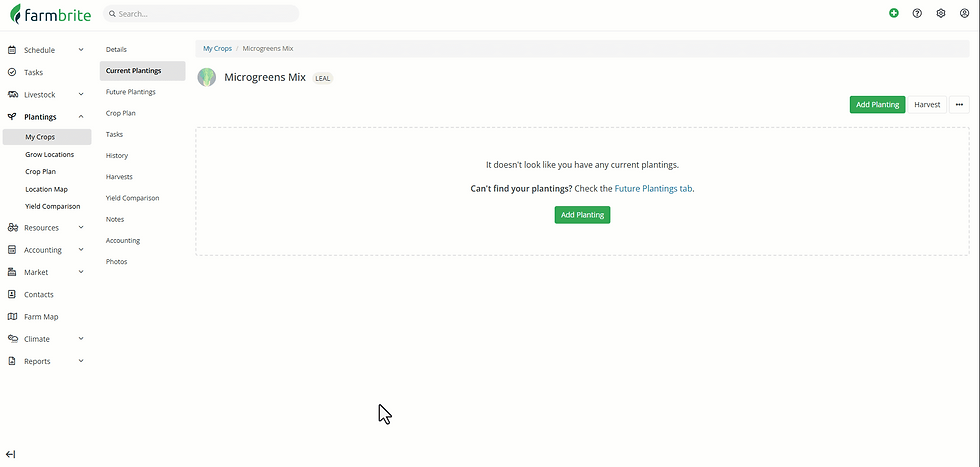
Like many farms that include a CSA as part of their operations, Meadow Bend grows and sells a variety of leafy greens, such as arugula, lettuce mixes, and microgreens. They indicate the crop type, and then the number of plantings they would like to get, and then the days in between each series of that crop, and Farmbirte calculates the current and future plantings, respectively. This is a huge time saver for Katie as she typically did this manually in a notebook at the start of the season, and as the farm broadened their offerings, this was becoming a nightmare!
Tracks Estimated Harvest Windows

Rather than relying on memory, an out-of-date spreadsheet, or sticky notes, John makes use of Farmbrite's Expected Harvest feature that tells him not only the harvest window it will most likley be ready, but also an expected yield based on the information they provided in the My Crops / Details for each crop they're growing.
As you'd expect, this is critical for their CSA operation as well as their work with the local restaurants.
Seed Starting & Greenhouse Management

The greenhouse used to be a guessing game.
Now, Farmbrite tracks:
Seeding dates
Germination and seedling timelines
Planted, vegetative, flowering, ripening, and complete dates
Transplant targets
Input usage (soil mix, trays, seeds)
Knowing how many peppers and tomatoes they'll need between their CSA and wholesale operations, using the Calculated Plantings tool, Farmbrite lets them work backwards from the harvest date window and the amount they need to have available.
The result? More consistent yields and fewer crop gaps.

Harvest & Yield Tracking: Knowing What Actually Pays
One of the biggest turning points for Meadow Bend was harvest tracking.

Before Farmbrite, they thought tomatoes were their most profitable crop. After logging harvest quantities, labor hours, seed and amendment costs, and their market price per unit, they discovered that specialty salad mix generated higher profit per bed foot.
Armed with real data, they adjusted production:
Increased salad mix beds by 20%
Reduced lower-margin crops
Focused on high-turnover greens for restaurant clients
In a micro-farm model, small decisions compound quickly. Accurate yield tracking changed their revenue strategy.
One System, Not Three for CSA and Direct Sales
Previously, CSA subscriptions were tracked in email threads and spreadsheets. Farmers' market revenue was recorded separately. Restaurant invoices were created manually.
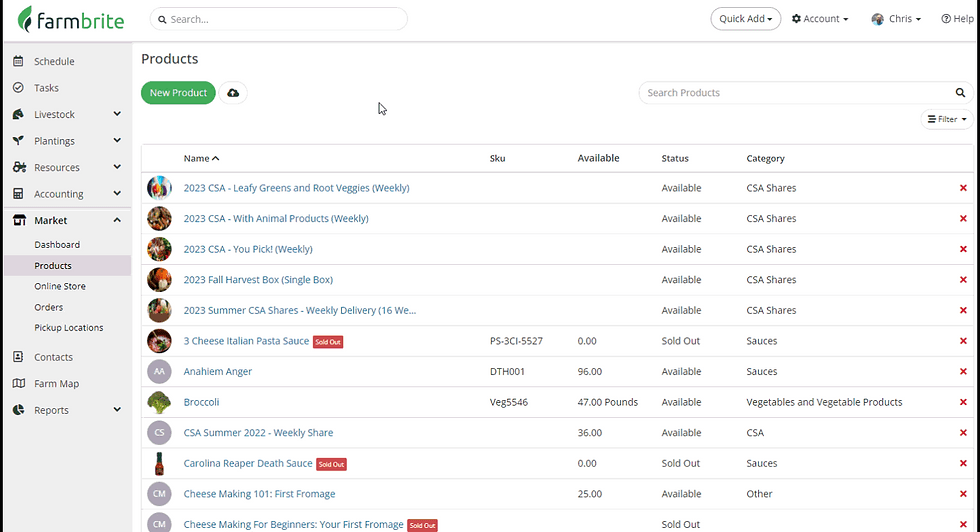
With Farmbrite, Meadow Bend's CSA members are tracked in one system, member payment history is recorded, the farm's product inventory aligns with available harvest, and their accounting reports show revenue by channel.
This clarity allowed Meadow Bend to evaluate:
Which market generated the highest margin
Whether to expand CSA membership
If and when to adjust pricing
They realized restaurant sales were consistent but had a lower margin than CSA boxes. The next season, they added 10 CSA members instead of expanding wholesale accounts.
Farmbrite offers many flexible ways to create and manage CSA offerings. Check out our how-to article, "Setting Up Farm Boxes and CSA Memberships As Products".
Preventing Downtime with Equipment and Maintenance

Micro-farms often rely on a single walk-behind tractor, irrigation pump, or delivery vehicle. If something breaks during peak season, operations stall. Scratch that - they can come to a screeching halt.

Farmbrite’s Equipment module allowed Meadow Bend to:
Log maintenance schedules and record repairs
Track cost of ownership
Set reminders for oil changes and inspections
And as with many areas of Farmbrite, you can create your own custom fields to record information specific to your equipment, maintenance, and usage that are not already included.
Now, instead of reacting to breakdowns, Katie and John plan preventive maintenance during slower production windows.
Getting Financial Clarity
The biggest impact came from integrated financial tracking.
Farmbrite was integral to helping Meadow Bend categorize their expenses (seeds, compost, labor, utilities, etc.), track their costs of production per crop, generate a profit and loss statement, among other detailed financial reports, and compare seasonal performance year over year.
At the end of their first full season using the platform, Meadow Bend could clearly answer:
Which 5 crops drove 60% of revenue
Their average revenue per bed foot
Their cost per CSA box

Additionally, Farmbrite took their ledger transactions and generated reports that specifically correlated with IRS Schedule F Tax Form 1040 categories by default, or they could customize their own chart of accounts for the categories that work for their business. This data-informed pricing adjusted the following season, increasing net income without increasing acreage.
Maximizing Limited Hands with Labor Management

With only three people working the farm at peak season, the timely and proper coordination of tasks matters. Katie and John could now keep a list of tasks, assign them to their seasonal worker, check in on the progress, and record how long they took to complete. Farmbrite’s task management features allowed Meadow Bend to:
Assign daily harvest lists
Track completed work
Schedule irrigation checks
Plan weekly market prep
Instead of a whiteboard that washed off in the rain, they now operate from a centralized digital task list accessible via mobile devices. And for farms with larger numbers of staff, Farmbrite allows you to create teams, assign roles and permissions within the system, and track all their hours.
Results That Speak for Themselves
After one full growing season using Farmbrite, Meadow Bend reported:
Fewer missed plantings
Reduced crop waste
Improved crop yield and cash flow predictability
Better understanding of profitability
More confidence regarding expansion decisions
Perhaps most importantly, Katie and John reported a substantial reduction in mental load. Instead of juggling notebooks and spreadsheets, they operate from one organized system.
Why Farmbrite Works Especially Well for Micro-Farms

Micro-farms may be small in acreage, but they are often more complex than larger single-crop operations. Diversification, succession planting, direct sales, and community relationships all add layers of management.
A system like Farmbrite centralizes:
Production planning
Sales management
Financial tracking
Equipment oversight
Customer relationships
For small-acreage operations where margins are tight and time is limited, that consolidation can be transformative. The difference between burnout and sustainability often comes down to systems.
For Meadow Bend Micro-Farm, adopting Farmbrite didn’t change how hard they worked, but it changed how effectively they worked.
And on 1.5 acres, efficiency is everything.


